Latest Info on Afghanistan gov spend, Public Purchasing, Govt budget & Public spending
- Home >
- Public Procurement
Public Procurement in Afghanistan
Public procurement in Afghanistan represents a central mechanism through which the government delivers public services, maintains infrastructure, and supports essential state functions. Government purchasing covers a broad spectrum of goods, works, and services ranging from civil construction and energy projects to healthcare supplies, education services, information technology, and professional consulting.
For domestic suppliers and international firms alike, government tenders in Afghanistan constitute one of the most structured entry points into the public sector market. Despite operational and institutional challenges, the procurement system is governed by a defined legal framework, centralised oversight, and an established electronic procurement platform.
Understanding how public procurement in Afghanistan operates - its rules, institutions, procedures, and limitations - is essential for bidders seeking to participate responsibly and competitively in public tenders.
Country & Economic Overview
| Country | Afghanistan |
| Region | South Asia |
| Population | 35.90 million (end-2025 projection; official estimates range 35.7-44.7 million) |
| Income Level | Low income= GNI per capita of $1,005 or less |
| Base Currency | Afghani (AFN) |
| GDP | USD 17.49 billion (end-2025 forecast; 2023 actual USD 17.15 billion) |
| GNI per Capita | USD ~500 (2023 latest; 2025 data pending, based on GNI USD 17.23 billion total) |
Public procurement historically represents a substantial share of Afghanistan’s public expenditure. According to officially reported data, public procurement expenditure accounted for approximately 19% of GDP, highlighting the strategic importance of government purchasing in the national economy.
Public Procurement Governance Framework
Public procurement in Afghanistan is centrally coordinated to ensure consistency, oversight, and control across government entities. The governance framework assigns both regulatory and operational responsibilities to a central authority while allowing line ministries to conduct procurements within defined rules.
| Public Procurement Authority | National Procurement Authority (NPA) |
| Central Purchasing Body | National Procurement Authority |
| Supervising Institution | Administrative Office of the President |
| Coverage | National |
The NPA functions as both the central regulatory authority and the central purchasing body for major and strategic procurements. It oversees procurement activities across sectors including agriculture, health, education, energy, transportation, water and sanitation, ICT, public administration, and social services.
Legal & Regulatory Framework
Public procurement law in Afghanistan provides the legal foundation for all government purchasing activities. The law defines procurement objectives, establishes procedural requirements, and introduces safeguards to ensure transparency and accountability.
Core Legal Principles
- Transparency and public disclosure
- Open and fair competition
- Value for Money (VfM)
- Total Cost of Ownership (TCO)
- Equal treatment of bidders
Key Legal Provisions
- Mandatory bid securities or bid declarations
- Public bid opening requirements
- Domestic preference provisions
- SME participation encouraged by law
- Defined complaint resolution timelines
The law allows for emergency procurement procedures and excludes certain donor-funded projects where alternative procurement rules apply, subject to agreed conditions.
Procurement Procedures & Thresholds
Procurement methods in Afghanistan are determined by contract value, complexity, and urgency. Thresholds and procedures are defined in the procurement law and its rules of procedure.
Main Procurement Methods
- Open Competitive Bidding (default method)
- Restricted or Limited Bidding
- Request for Quotations
- Direct Contracting (exceptional cases only)
| Procedure Element | Legal Status |
| Bid Validity Period | Defined by law for goods, works, and services |
| Standstill Period | Mandatory before contract signing |
| Advertisement Timeline | Minimum days prescribed by law |
| Contract Award Disclosure | Mandatory above defined thresholds |
eProcurement System Overview
The eProcurement system in Afghanistan is known as the Afghanistan Government Electronic Open Procurement System (AGEOPS). It was introduced to enhance transparency, efficiency, and accessibility of public procurement processes.
| System Name | AGEOPS |
| Launch Year | 2018 |
| Ownership Model | Government-owned and operated |
| Core Functionalities | eTendering, vendor registration, procurement planning, contract management |
| Languages Supported | English, Pashto, Persian |
| Currencies Supported | Afghani, USD, Euro |
The system supports electronic publication of tenders, digital submission of bids, and electronic contract management. Procurement data is also published in alignment with open contracting data standards.
Procurement Market Characteristics
Afghanistan’s public procurement market covers three main categories: goods, works, and services. Works contracts, particularly infrastructure and construction, have historically represented a significant share of procurement activity.
- Goods: Medical supplies, equipment, fuel, ICT hardware
- Works: Roads, buildings, water systems, energy infrastructure
- Services: Consulting, training, technical assistance
Both domestic and international firms are eligible to participate. SME participation is encouraged by law; however, detailed statistical data on SME awards is not publicly available.
Bid evaluation methods include lowest evaluated price and the Most Economically Advantageous Tender (MEAT) approach, depending on the nature of the procurement.
Transparency, Complaints & Oversight
Transparency is reinforced through mandatory publication of tenders and contract awards, public bid openings, and defined oversight mechanisms.
Complaint Mechanism
- Submission of complaint within legally defined timelines
- Formal review by the designated authority
- Decision issued within the statutory resolution period
Annual procurement reports and selected statistics are published by the responsible authority. However, comprehensive and up-to-date procurement statistics are not publicly available.
Sustainability & Green Public Procurement
Afghanistan does not currently have a formal green public procurement strategy or mandatory environmental procurement requirements. While sustainability concepts are referenced in law, their application is not standardized.
- No mandatory green procurement criteria
- No defined environmental disposal requirements
- No official green supplier certification requirements
Any sustainability-related considerations are applied on a case-by-case basis rather than through a unified national policy.
Social & Ethical Procurement Considerations
The public procurement law does not include mandatory requirements for awards to women-owned businesses or disadvantaged groups. Similarly, there are no explicit legal obligations for suppliers to adhere to international labor standards or ethical sourcing rules within procurement procedures.
As a result, social and ethical procurement considerations remain largely outside the formal procurement evaluation framework.
Key Challenges & Practical Insights for Bidders
Suppliers engaging in government tenders in Afghanistan should be aware of practical challenges that may affect procurement participation.
Key Challenges
- Institutional capacity constraints
- Limited availability of procurement statistics
- Operational risks and procedural delays
- Donor-driven procurement processes operating alongside national systems
Practical Bidding Insights
- Register early on the eProcurement system
- Closely follow tender documentation and deadlines
- Ensure full compliance with bid security requirements
- Monitor award notices and standstill periods carefully
With careful preparation and compliance, suppliers can position themselves effectively within Afghanistan’s public procurement environment.
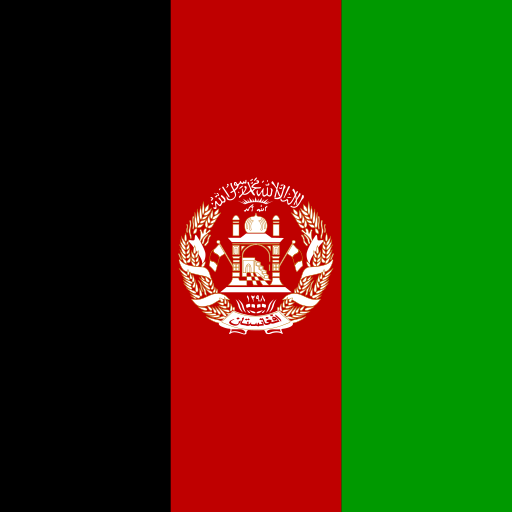
Flag of Afghanistan
Emblem of Afghanistan
Capital
Kabul
ISO 3166 Code
AF
Population
26,556,800
Area, Sq KM
647,500
Currency
Afghani
GDP, Billion USD
20,497
Language
Pashto, Dari (Persian)
GDP Growth Rate, %
3.2
Inflation, Avg CP, %
15.0
Interest Rates, %
-
Unemployement Rate, %
-
Exchange Rate, 1 USD Equals
60.0
International dial code
93
Time ZONE
GMT+04:30
Internet TLD
.af
Get FREE SAMPLE TENDERS from Afghanistan in your email inbox.
Copyright © 2014-2026 AfghanistanTenders.com. All Rights Reserved.